[sticky entry] Sticky: The Illiad: Schedule

Dec. 31st, 2018 02:01 pm
acequeenking: Persephone - Dante Gabriel Rosetti (Default)
[personal profile] acequeenking
 An image - “The anger of Achilles for the loss of Briseis” (1769) Artist: Domenico Cunego
“The anger of Achilles for the loss of Briseis” (1769)
Artist: Domenico Cunego
Reading Schedule

Books 1-3: January 1 - January 6
Books 4-6: January 7 - January 13
Books 7-9: January 14 - January 27
Books 10-12: January 28 - February 10
Books 13-15: February 11- February 24
Books 16-18: February 25- March 10
Books 19-21: March 11 - March 24
Books 22-24: March 25 - April 8

The rules are quite easygoing and the schedule is mostly meant to provide structure to discussions. Each week I'll put up a discussion post focusing on the chapters in the reading, though you, of course, may bring up past chapters in newer posts.

(I do ask if you post something from a future chapter - for example, posting about Book 5 in Book 1-3's post - that you mark it in the title with spoilers to try to keep new readers from being accidentally spoiled. Everyone may know the rough idea of this work but certainly not every detail will be known to every reader.)

You may read ahead if you'd like to, and if you fall behind I'll post summaries to try to keep everyone up to speed on the most important facts. I am admittedly winging it a bit in terms of how much reading per week - my goal was to try to keep it in the fifty to one hundred page range, since it isn't always easy reading. I opted for 3 chapters instead of 4 because I felt more often than not, the narrative hit a better end-point in the third chapter instead of the fourth. I'm all ears for constructive crit on how to adjust the schedule going forward.

EDIT: I have updated the schedule as it was proving too much to do 3 chapters per week for the group. We will be doing 3 chapters every two weeks from now on. Hopefully the slower schedule will help!
acequeenking: Persephone - Dante Gabriel Rosetti (Default)
[personal profile] acequeenking

Toledo Amphora showing the ransolm of Hector
 
Respect the gods now. Have pity on me; remember
your father. For I am more to be pitied than he is,
since I have endured what no mortal ever endured:
I have kissed the hands of the man who slaughtered my children.’
The Iliad Book 24 (Mitchell translation)
 

Discussion Post Rules:
  • Be polite, be courteous. Some people will not agree on things, and constructive discussions are fine (e.g.: "I don't agree Achilles is a flying fish, if you look at this passage, he is clearly man-like, not fishlike, and no gills were mentioned"), personal insults are not (e.g.: "Achilles is dumb, and so are you if you think he's a fish.")
  • Discussion of outside sources/links/fanfiction/fanart/other books/etc encouraged but not required.
  • There is no such thing as a stupid question or comment. All thoughts encouraged.
  • If you want to talk about something in a book or other story set beyond the current discussion (for example: something in the Odyssey), please label your post with spoilers somewhere in the title.
  • If you are behind in the readings or just starting, feel free to start with where we are now, or comment on things that have happened earlier in the book on the latest post. We will enjoy your observations regardless of your reading speed.
  • As a reminder, the schedule has changed so discussion on this post will now last 2 weeks instead of one.
  • Next week we'll be talking about what we might do after this work! 
  • Apologies on being super behind on the major characters/summaries. Work hit me hard the last month. :( I will try to catch up on them when I can, but if someone else wnats to step in and write them feel free. 
acequeenking: Persephone - Dante Gabriel Rosetti (Default)
[personal profile] acequeenking
  
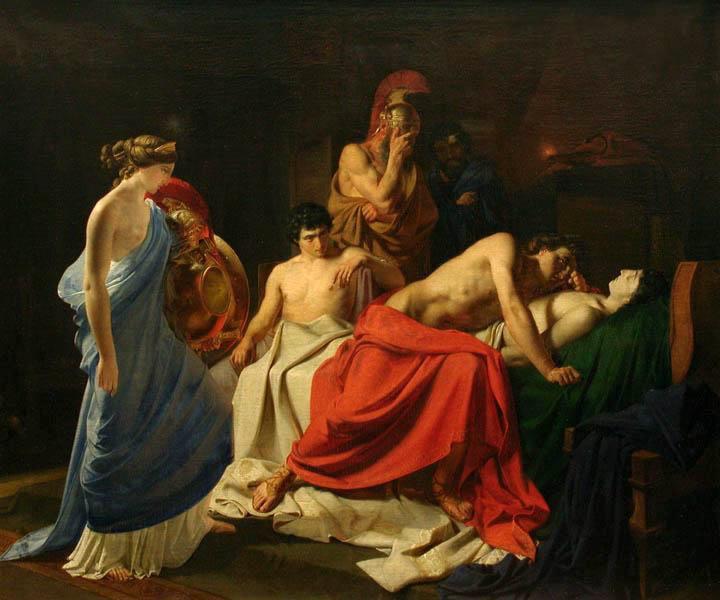
Achilles and the body of Patroclus (1855) by Nikolai Ge
 
So the blessed gods stirring on the opponents drove them
 together, and broke out among themselves the weight of their quarrel.
From high above the father of gods and men made thunder terribly,
while Poseidon from deep under them shuddered all the illimitable earth,
the sheer heads of the mountains.
And all the feet of Ida with her many waters were shaken
and all her crests, and the city of Troy, the ships of the Achaians.
Aïdoneus, lord of the dead below, was in terror
and sprang from his throne and screamed aloud,
for fear that above him he who circles the land, Poseidon,
might break the earth open and the houses of the dead lie open
to men and immortals ghastly and moldering, so the very gods shudder before them;
such was the crash that sounded as the gods came driving together in wrath.

The Iliad - Book 20 (Lattimore translation)


Discussion Post Rules: 
  • Be polite, be courteous. Some people will not agree on things, and constructive discussions are fine (e.g.: "I don't agree Achilles is a flying fish, if you look at this passage, he is clearly man-like, not fishlike, and no gills were mentioned"), personal insults are not (e.g.: "Achilles is dumb, and so are you if you think he's a fish.") 
  • Discussion of outside sources/links/fanfiction/fanart/other books/etc encouraged but not required.
  • There is no such thing as a stupid question or comment. All thoughts encouraged. 
  • If you want to talk about something in a book or other story set beyond the current discussion (for example: something in the Odyssey), please label your post with spoilers somewhere in the title.
  • If you are behind in the readings or just starting, feel free to start with where we are now, or comment on things that have happened earlier in the book on the latest post. We will enjoy your observations regardless of your reading speed. 
  • As a reminder, the schedule has changed so discussion on this post will now last 2 weeks instead of one. 
acequeenking: Persephone - Dante Gabriel Rosetti (Default)
[personal profile] acequeenking
 
Red-figure crater from Sicily (c500 BCE)
 
Thus he spoke; but Patroclus armed himself in glittering brass. First, indeed, he put the beautiful greaves around his legs, fitted with clasps; next he placed the corslet of the swift-footed descendant of Æacus upon his breast, variegated, and studded with stars; and suspended from his shoulders his silver-studded sword, brazen, and then the great and sturdy shield. But upon his gallant head he placed the well-made helmet, crested with horse-hair; and dreadfully the plume nodded from above. He took besides two strong spears, which well fitted his hands; but the spear alone of blameless Æacides, ponderous, large, and strong, he did not take; which, indeed, no other of the Greeks could brandish, but Achilles alone knew how to wield it; a Pelian ash which Chiron had given to his sire, [cut] from the tops of Pelion, about to be death to heroes. He also commanded Automedon quickly to yoke the steeds, whom, next to rank-breaking Achilles, he most honoured, because he was most faithful to him in battle, to stand the charge.
(Iliad Book 16, Buckley Translation)


Discussion Post Rules: 
  • Be polite, be courteous. Some people will not agree on things, and constructive discussions are fine (e.g.: "I don't agree Achilles is a flying fish, if you look at this passage, he is clearly man-like, not fishlike, and no gills were mentioned"), personal insults are not (e.g.: "Achilles is dumb, and so are you if you think he's a fish.") 
  • Discussion of outside sources/links/fanfiction/fanart/other books/etc encouraged but not required.
  • There is no such thing as a stupid question or comment. All thoughts encouraged. 
  • If you want to talk about something in a book or other story set beyond the current discussion (for example: something in the Odyssey), please label your post with spoilers somewhere in the title.
  • If you are behind in the readings or just starting, feel free to start with where we are now, or comment on things that have happened earlier in the book on the latest post. We will enjoy your observations regardless of your reading speed. 
  • As a reminder, the schedule has changed so discussion on this post will now last 2 weeks instead of one. 

acequeenking: Persephone - Dante Gabriel Rosetti (Default)
[personal profile] acequeenking
 
Berry, James - Jupiter und Juno auf dem Berge Ida (Jupiter and June On top of Mount Ida), 1790–99 
 
"Then grant me (said the queen) those conquering charms,
That power, which mortals and immortals warms,
That love, which melts mankind in fierce desires,
And burns the sons of heaven with sacred fires!"
(Book XIV, Pope Translation)


Discussion Post Rules: 
  • Be polite, be courteous. Some people will not agree on things, and constructive discussions are fine (e.g.: "I don't agree Achilles is a flying fish, if you look at this passage, he is clearly man-like, not fishlike, and no gills were mentioned"), personal insults are not (e.g.: "Achilles is dumb, and so are you if you think he's a fish.") 
  • Discussion of outside sources/links/fanfiction/fanart/other books/etc encouraged but not required.
  • There is no such thing as a stupid question or comment. All thoughts encouraged. 
  • If you want to talk about something in a book or other story set beyond the current discussion (for example: something in the Odyssey), please label your post with spoilers somewhere in the title.
  • If you are behind in the readings or just starting, feel free to start with where we are now, or comment on things that have happened earlier in the book on the latest post. We will enjoy your observations regardless of your reading speed. 
  • As a reminder, the schedule has changed so discussion on this post will now last 2 weeks instead of one. 
acequeenking: Persephone - Dante Gabriel Rosetti (Default)
[personal profile] acequeenking
Dolon (center) meets Diomedes (right) and Odysseus (left).
4th century Lucanian red-figure calyx-crater from Pisticci. 
 
And to Odysseus Meriones gave quiver, bow​ and sword;
and round his head he placed his helmet
made of hide, stretched tight inside with many thongs,
while outside the white-shining teeth of a bright-tusked boar ran close-set round and round,
well and skillfully applied, and felt was fitted in the center;
this in time before Autolykos had carried out of Eleon,
after breaking into the snug house of Amyntor son of Ormenos,
and Autolykos then gave it to Amphidamas of Cythera to take to Skandeia,
and Amphidamas gave it to Molos as a guest-gift,
and he gave it to his son Meriones to carry with him.
And now it was put around and protected Odysseus’ head.
Then the two stepped into their dread armor,
and went their way, and left behind there all the other nobles.
And to them, on the right hand near the path,
Pallas Athena sent a night heron;
they did not see it with their eyes through the murk of night,
but heard its ringing cry.
Book 10, Lines 260-76 (Alexander translation)
 
 
Discussion Post Rules: 
  • Be polite, be courteous. Some people will not agree on things, and constructive discussions are fine (e.g.: "I don't agree Achilles is a flying fish, if you look at this passage, he is clearly man-like, not fishlike, and no gills were mentioned"), personal insults are not (e.g.: "Achilles is dumb, and so are you if you think he's a fish.") 
  • Discussion of outside sources/links/fanfiction/fanart/other books/etc encouraged but not required.
  • There is no such thing as a stupid question or comment. Crack encouraged. 
  • If you want to talk about something in a book or other story set beyond the current discussion (for example: something in the Odyssey), please label your post with spoilers somewhere in the title.
  • If you are behind in the readings or just starting, feel free to start with where we are now, or comment on things that have happened earlier in the book on the latest post. We will enjoy your observations regardless of your reading speed. 
  • As a reminder, the schedule has changed so discussion on this post will now last 2 weeks instead of one. 
acequeenking: Persephone - Dante Gabriel Rosetti (Default)
[personal profile] acequeenking
There will be no new post this week, as we're switching from 3 chapters per week to 3 chapters every two weeks. If you've fallen behind, I encourage you to go ahead and post any observations for books 1-9 on the most recent discussion post. If you want to make sure you've got a copy of the new schedule, I've updated it here.

Next post goes up on Monday, January 28.
acequeenking: Persephone - Dante Gabriel Rosetti (Default)
[personal profile] acequeenking


Athenian red-figure wine-cup showing the duel between Hector and Ajax, 490–480 BC.
 
 
Holding this shield before him, Ajax son of Telamon came close up to Hector, and menaced him saying, "Hector, you shall now learn, man to man, what kind of champions the Danaans have among them even besides lion-hearted Achilles cleaver of the ranks of men. He now abides at the ships in anger with Agamemnon shepherd of his people, but there are many of us who are well able to face you; therefore begin the fight."

And Hector answered, "Noble Ajax, son of Telamon, captain of the host, treat me not as though I were some puny boy or woman that cannot fight. I have been long used to the blood and butcheries of battle. I am quick to turn my leathern shield either to right or left, for this I deem the main thing in battle. I can charge among the chariots and horsemen, and in hand to hand fighting can delight the heart of Mars; howbeit I would not take such a man as you are off his guard- but I will smite you openly if I can."
Book 7 (Butler translation)

Discussion Post Rules: 
  • Be polite, be courteous. Some people will not agree on things, and constructive discussions are fine (e.g.: "I don't agree Achilles is a flying fish, if you look at this passage, he is clearly man-like, not fishlike, and no gills were mentioned"), personal insults are not (e.g.: "Achilles is dumb, and so are you if you think he's a fish.") 
  • Discussion of outside sources/links/fanfiction/fanart/other books/etc encouraged but not required.
  • There is no such thing as a stupid question or comment. Crack encouraged. 
  • If you want to talk about something in a book or other story set beyond the current discussion (for example: something in the Odyssey), please label your post with spoilers somewhere in the title.
acequeenking: Persephone - Dante Gabriel Rosetti (Default)
[personal profile] acequeenking
 Sculpture of Athena counseling Diomedes shortly before he enters the battle, sculpted by Albert Wolff, 1853
Sculpture of Athena counseling Diomedes shortly before he enters the battle, sculpted by Albert Wolff, 1853
 
'When Athenaean Pallas on the son
Of Tydeus, Diomede[s], new force conferr'd
And daring courage, that the Argives all
He might surpass, and deathless fame achieve.
Fires on his helmet and his shield around                 
She kindled, bright and steady as the star
Autumnal, which in Ocean newly bathed
Assumes fresh beauty; with such glorious beams
His head encircling and his shoulders broad,
She urged him forth into the thickest fight.'
Book 5, Lines 1-10 (Cowper translation)
 
 
Discussion Post Rules: 
  • Be polite, be courteous. Some people will not agree on things, and constructive discussions are fine (e.g.: "I don't agree Achilles is a flying fish, if you look at this passage, he is clearly man-like, not fishlike, and no gills were mentioned"), personal insults are not (e.g.: "Achilles is dumb, and so are you if you think he's a fish.") 
  • Discussion of outside sources/links/fanfiction/fanart/other books/etc encouraged but not required.
  • There is no such thing as a stupid question or comment. Crack encouraged. 
  • If you want to talk about something in a book or other story set beyond the current discussion (for example: something in the Odyssey), please label your post with spoilers somewhere in the title.
acequeenking: Persephone - Dante Gabriel Rosetti (Default)
[personal profile] acequeenking
 
 
"Zeus and Thetis." 1769. Anton Losenko. 

Rage—Goddess, sing the rage of Peleus’ son Achilles,
murderous, doomed, that cost the Achaeans countless losses,
hurling down to the House of Death so many sturdy souls,
great fighters’ souls, but made their bodies carrion,
feasts for the dogs and birds,
and the will of Zeus was moving toward its end.
Begin, Muse, when the two first broke and clashed,
Agamemnon lord of men and brilliant Achilles.
Book 1, lines 1-8 (Fagles translation)

Discussion Post Rules: 
  • Be polite, be courteous. Some people will not agree on things, and constructive discussions are fine (e.g.: "I don't agree Achilles is a flying fish, if you look at this passage, he is clearly man-like, not fishlike, and no gills were mentioned, s"), personal insults are not (e.g.: "Achilles is dumb, and so are you if you think he's a fish.") 
  • Outside sources/links/fanfiction/fanart/etc encouraged but not required.
  • There is no such thing as a stupid question or comment. Crack encouraged. 
  • If you want to talk about something in a book or other story set beyond the current discussion (for example, something in the Odyssey), please label your post with spoilers somewhere in the title.
acequeenking: Persephone - Dante Gabriel Rosetti (Default)
[personal profile] acequeenking

What is the Iliad about, and why should I read it?

The Iliad is a famous work of ancient literature, one of the building blocks of western lit; it's also one surprisingly shippy, with two men so close that at least one movie adaptation made them "cousins" to try to discourage it from being seen as a love story (sidenote: it did not work). It's a war story set in a time of gods and men, and all of them are pissed off and trying to cram a walnut in the other's face.

The war all began because a Trojan prince (Paris) ran off with a greek queen (Helen, of Troy, formerly of Sparta) and her husband and a whole bunch of his best buddies run off to Troy. The Iliad begins in-media-res during the war, with two of the Greek commanders fighting bitterly over an enslaved woman, taken as a spoil of war.

Which Version of the Iliad should I read?

Good question, without a good answer. There are, roughly, a million and a half different versions of the Iliad. What version is right for you is MOSTLY a matter of personal preference; some are written in prose, some retain the poetic structure homer used (dactylic hexameter), others translate it into blank verse, rhyming couplets, sonnets, and more. This page has an exhaustive list of different options, including links to the complete text for most of the ones that are out of copyright, along with reviews for those as well as those still in copyright that are available for sale. I recommend clicking through a few until you find a version you like...but if you don't want to do that, I'm going to recommend a couple options, divided between free/not free for several versions:

Commercial
Generally, most college or high school programs that teach the Iliad today recommend either the Lattimore or Fagles translations. The Lattimore translation is straightforward and faithful to the original greek text to a fault, up to keeping the Greek spellings for names, ie Achilles is referred to as “Achilleus”; Ajax is “Aias". On the other hand, the Fagles translation more dramatic and less literal, but it takes liberties that wind up sacrificing parts of the Greekishness of it all - the epithets being a major change, eg "Hector of the shining helmet" instead becomes "Hector's helmet flashed." A problem with both of these options is that none of these are free, but both are commonly available in libraries.

I would also like to spotlight a very recent translation, that by Caroline Alexander. This is the first translation done by a woman, and is one that tries to make a complete line for line translation of the Greek epic and aims for faithfulness to the Greek overall.

Free Options

They are by no means the only translations, however; the extremely popular (and extremely out of copyright) translation by Alexander Pope is widely considered to be one of the most eloquent of the poetic translations, and was certainly the most popular version available in the 18th/19th century. While it takes some liberties with the text, it is certainly evocative and offers the sort of verbal melody that Homer's audience would have been familiar with. One Caveat: All the names have been translated to the Latin names, so Zeus becomes "Jove"; Hades becomes "Pluto" and so on. I'll make a point, when doing any listing of the character names, of including both the Greek and Latin names, when they differ.

For a more literal-minded free prose version, the version translated by Theodore Alois Buckley takes few liberties and gives exhaustive notes as to why Buckley has translated phrases one way or another. If you can read ancient Greek or would like to learn, this will give you plenty of exposure, and insight, into how this was translated. However, it can be a "plainer" translation in many ways. It can also be a bit indecisive on the names used; eg Hades is used as the name for the realm of the dead but the god of the dead is referred to as Pluto -- but Zeus is "Jove"; Athena, "Minerva". This can make it confusing for anyone coming into this without a solid knowledge of the Latin names of these characters.

Many of the out of copyright versions can be downloaded from Project Gutenberg as well.

Audiobooks

The Iliad was originally an epic poem that was spoken aloud! If you would like to experience it the way the ancient Greeks did, there are MANY audiobooks available. Librivox has several free versions in a variety of languages. Audible also boasts many professionally recorded versions, including the Alexander, Fagles, and Lattimore editions, though the only thing free are samples.

Is there any content that might be considered triggering to sensitive readers?

Yeah. This book has a lot of battles, and therefore, a lot of violence. There's considerable amounts of violence, considerable description of gore resulting from said violence and at least one suggestion of rape.

Is there anything I should know before starting this if I'm not familiar with Greek mythology?

Yes. Because this opens in-media res, it does not provide an explanation for what brought the Greeks to war with the Trojans. Thankfully, this page does quite a good job of describing what happened before the epic began: which is mostly, bitter infighting, over apples. Yep. Apples

We will begin reading on January 1. On that day, I will post up a post with a summary and dramatis personae of the first chapters for that week. The chapters read will remain the same no matter which version you choose, so go with whatever you would like. 
acequeenking: Persephone - Dante Gabriel Rosetti (Default)
[personal profile] acequeenking
Alright, looking at the responses to our interest survey, there's a strong preference to at least start with classical lit in the most classical sense, which means we'll start with the classical definition: ancient Greek and Roman literature.

So: there's been a lot of talk about the Illiad, which I think is a pretty good place to start, given its one of if not the oldest of the Greek classics. It has 24 books, and a bazillion different translations of that I will write up some notes on the differences this weekend.

Downsides to this though: it starts in media res of the Trojan war and it assumes you know the basic ideas of that story, and it's a long read (by ancient standards) with 24 chapters, which makes me think it would be best to actually spend six to eight weeks reading the Illiad so we can properly enjoy it and not be rushed to read 24 chapters all in four weeks.

After that, I'm thinking we can go in a pattern of long/short/short in terms of works; so something long like the Illiad would be followed by shorter poetry selections or a play (or both!) before we gear ourselves up to tackle something like the Oddessey. Right now my plan is: Major Epic/Big Famous Work -- Poetry -- Play -- Big Epic/Famous Work.

So, to that end, other than the Illiad, what else would you all like to read? Wiki's page on Ancient Greek/Roman lit covers most of the big works produced in this period, so shout at me what looks good. Otherwise, you're all getting what I like, and what I like is mostly drama/trauma!

My plan is to make a schedule for the Illiad this weekend (apologies, I forgot it was Christmas and have been out of town, I'll have it up Wednesday) and start advertising on meme and fandom calendar; we will start reading and discussing the Illiad on January 1!

We also now have an EAD chatroom on discord, so please come join us there as well! My thought is we'll have discussion posts here, but also be able to use the chat room for quick observations and/or questions.
acequeenking: Persephone - Dante Gabriel Rosetti (Default)
[personal profile] acequeenking
The first meeting of the Classic Literature Club will now come to order! *bangs gavel*

So: We were talking on EAD and it looks like there's some interest in doing a classic literature club, which YAY! But then I have a few questions:
  • What eras should we focus on? Ancient Greek only? Roman? Everything in the public domain?
  • What format would you prefer? Would people be more interested in a club where someone can make a post for a book, and people can fill in comments on various chapters/scenes, or just to comment generally, similar to [community profile] crack_van used to introduce fandoms, and maybe do a TL;DR summary as we go if we're gonna work with chapters since, well, we're all adults and sometimes shit happens and you can't read a couple chapters, and I'd rather have people continue with us than not. Would this be fun for others or is this overthinking the concept?
  • I'm all for this idea and I'm hoping you all agree. <3 Looking forward to reading some ancient greek classics at the very least with you all. :D 


Page generated Jan. 8th, 2026 02:21 pm
Powered by Dreamwidth Studios